

.png)
Financial decisions keep moving from humans to machines. Fraud alerts, credit line changes, claims payouts, and increasingly the loan decision itself now run through a system before anyone reviews the file.
Tunnl wanted to know how far Americans are actually willing to let that go, so we asked directly: who they trust with their money, who they blame when something goes wrong, and how much they're willing to hand over to a machine with no one to appeal to.
What came back this wave tells a clear story. Self-directed research for decision-making is beating every bank and advisor combined. Blame does not disappear just because a decision gets automated. And most Americans have a hard limit on how much they'll accept without a person still somewhere in the loop.
Who do Americans trust with their money right now?
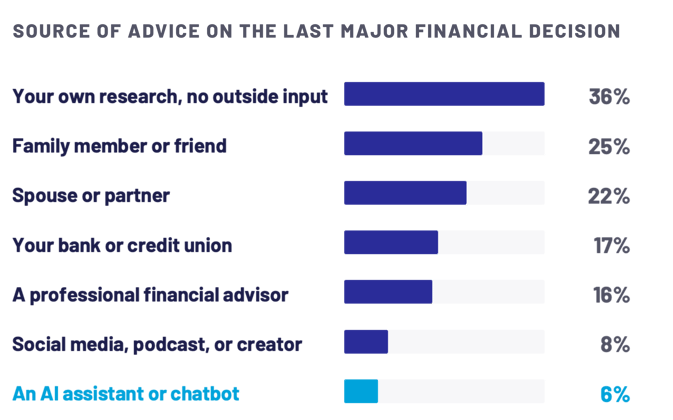
Not a bank. Not an advisor. Not an AI chatbot. When Americans describe the single biggest influence on their last major financial decision, their own research outpaces every institution and every professional relationship combined.
Family and a spouse or partner come next, well ahead of banks, advisors, creators, and AI, in that order. The self-directed researcher is now the largest single group in American personal finance, and it isn't close.
That matters more for marketing than it does for banking. Whatever a financial brand publishes, and whatever shows up when someone searches a comparison, a rate, or a story about a denied claim, is doing more of the persuading than a banker or an advertisement ever will. The self-directed researcher is already the audience. The only question is what they find when they go looking.
Is AI already replacing traditional financial advice for younger Americans?
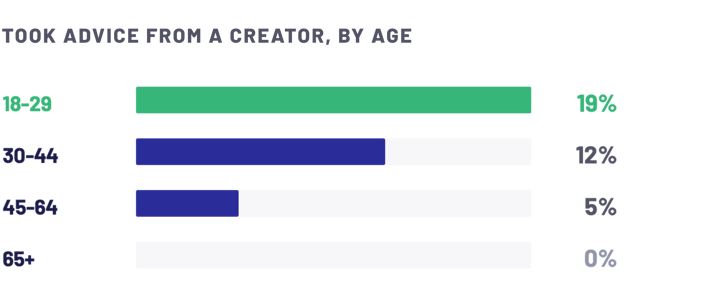
It depends entirely on who you ask. Among the youngest adults surveyed, a meaningful share points to a creator, podcast, or social post as the reason behind their last major financial decision. Among the oldest adults, essentially none do.
Men lean into this format more than women, and Republicans somewhat more than Democrats. The pattern isn't a coincidence, it maps onto exactly who already spends the most time with podcasts, YouTube, and long form social content. Financial advice is simply following people to where they already are.
For financial brands courting a younger customer base, that's more of a distribution problem than a trust problem. The audience is already listening to somebody. The only real choice left is whether it's a competitor's affiliate deal, an unaffiliated creator, or a credible voice the brand put there itself.
Who do Americans blame when a financial decision goes wrong?
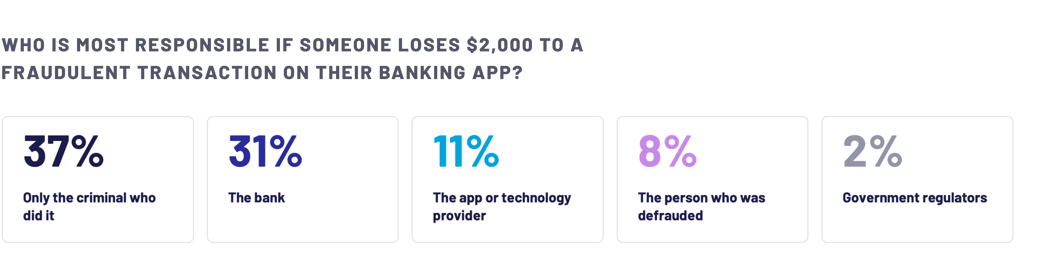
When someone loses money to a fraudulent transaction, the criminal takes the most blame, but not by the margin you'd expect. Combine the share who blame the bank with the share who blame the app or technology behind it, and 42% of Americans point at the institution, more than point at the criminal who actually committed the fraud.
That 42% is the number every financial brand automating decisions and reviewing security frameworks should sit with. Whatever goes wrong, the institution still primarily owns it in the customer's eyes. The same logic likely extends past banking. Ask about a denied insurance claim or a wrongful account freeze and the pattern probably holds: whoever built the system that made the call inherits the blame for it, automated or not.
Where do Americans want more government oversight in finance?
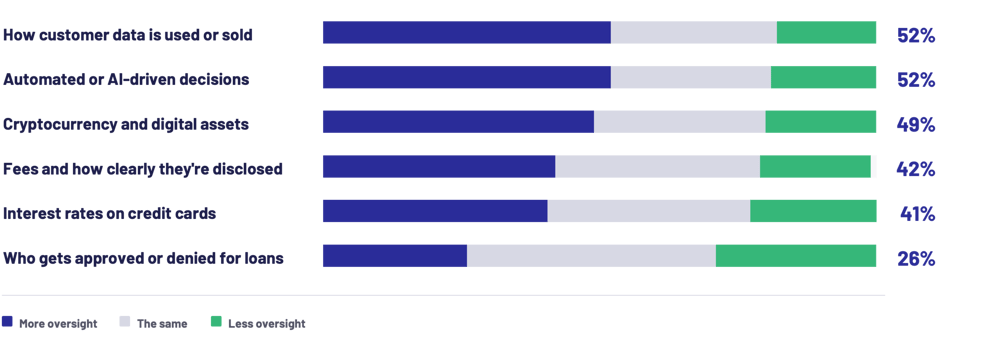
The parts of finance Americans understand least are the parts they want watched most closely. Two categories draw majority support for more oversight, and both sit behind the interface where most people can't see or verify anything for themselves: how their data gets used, and how automated or AI driven decisions get made.
Interest rates and fee disclosure trail behind. Those are printed on a statement, visible and already assumed to be regulated, so the appetite for still more oversight there is real but smaller.
Why does loan approval buck the oversight trend?
One category breaks the pattern entirely. When it comes to who gets approved or denied for a loan, more Americans want less oversight than want more, the only place in the entire survey where that's true.
Loan underwriting is old and assumed to already be governed. An automated model making that same call reads as new, opaque, and governed by no one, which is exactly the trust gap financial brands need to close before regulators close it for them.
Would Americans accept a financial decision made entirely by AI?
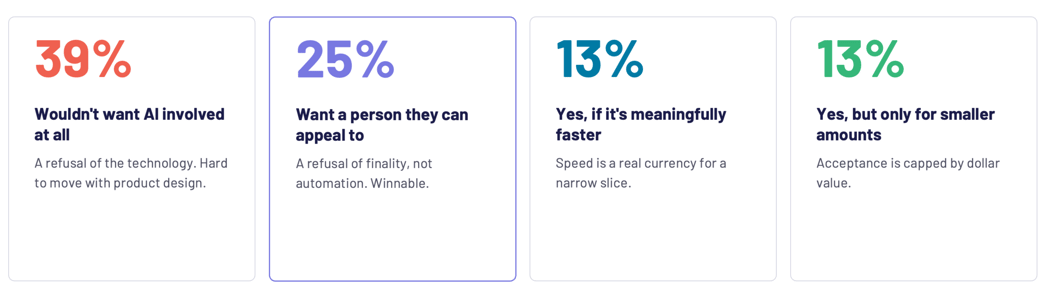
No. A clear majority, 63%, would not accept a faster loan or claims decision made entirely by AI with no human appeal.
That majority splits into two very different mindsets: outright rejection of the technology itself, and a demand for a real appeal option rather than a blanket no to automation. A much smaller group would accept a fully automated decision, but only if it were meaningfully faster, or only for smaller dollar amounts.
That's also a warning for any fintech betting its entire differentiation on speed. Same day funding and instant approvals matter to a real slice of the market, but it's a narrow one. For everyone else, faster isn't the trade they're making.
What should financial brands take from this?
Four things follow if these numbers hold, and each one points to a different part of the roadmap.
1.) Keep a visible off ramp on every automated decision.
Most of the people who reject AI-only outcomes are asking for someone to appeal to, not asking for the technology to disappear. That's a design problem, not a technology problem, and it's solvable.
2.) Put the guardrails where the anxiety already lives.
Oversight demand concentrates on the systems people can't see, not the ones already printed on a statement. Publish how a model works, not just that one exists, before a regulator or a headline forces the disclosure.
3.) Treat loan and credit decisions as the one place automation needs the most restraint, not the least
This is one of the biggest calls a financial brand can make about someone's life, yet it's the one place where people actually want less oversight. Don't mistake that for a green light to cut corners on transparency. It just means the process already feels like a black box to most people, and bolting an unexplained model onto it won't change that.
4.) Remember who owns the outcome
Self-directed research means influence is more fragmented than ever, but the institution and its technology stack still absorb more blame than the criminal who caused the loss. Whatever a brand automates, it inherits the blame for it too.
This is exactly the kind of brand research financial institutions need before they hand over one more decision to a system. The data says Americans aren't rejecting automation. They're rejecting decisions with nobody to answer to.
Download these Insights
Download this in PDF form so you can bring these numbers into your next roadmap conversation. It carries every stat in this piece, plus the full generational, gender, and political breakdown behind who's already turning to creators for financial advice.
Download our full insights here
If you're interested in exploring more consumer research on financial trust and technology, request a demo here.
Tunnl runs a national omnibus survey multiple times each month. This online survey of 3,066 U.S. adults was fielded between July 31 and August 4, 2026. Results are weighted to be representative of the national adult population. Some questions allowed multiple selections, so figures may not total 100%.